
Pool and Spa Electrical: Bonding, Disconnects, and What MN Code Requires

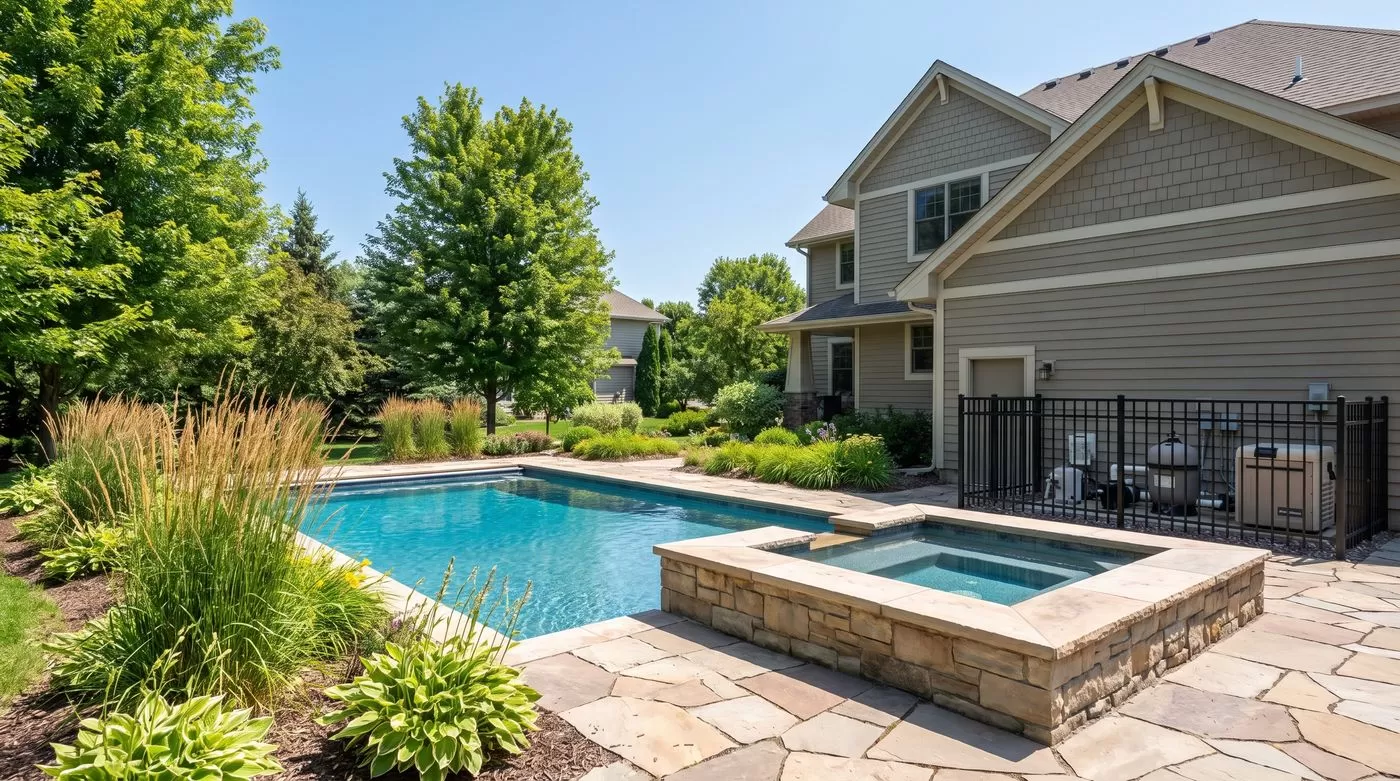
Pool and spa electrical is one of the few residential areas where the consequence of doing it wrong is potentially fatal. The hazard is “step potential” — a small voltage difference between the water and the deck/ground that can cause an electric shock or worse. The code answer is equipotential bonding: tying every metal object in and around the pool to a single shared ground reference. It’s not optional, it’s not DIY, and every code cycle has tightened it. Here’s what MN code requires.
Equipotential Bonding: What It Actually Is
Equipotential bonding means every conductive object within 5 feet of the pool/spa (ladders, handrails, pump housings, light fixtures, metal coping, rebar in concrete decks) gets tied together with a continuous #8 AWG solid copper bonding wire and connected to the pool’s bonding grid. The goal isn’t to ground these objects to earth — it’s to make sure they’re all at the same electrical potential, so a person touching two of them simultaneously can’t get shocked by a difference.
For in-ground pools, the bonding grid often includes the rebar in the gunite shell during construction. For above-ground pools, all metal frame components and any metal coping or perimeter must be bonded. Spas (hot tubs) bond the pump, heater, motor housings, and any metal frame. This is NEC Article 680, and Minnesota adopts it directly.
Disconnects, GFCI, and Required Clearances
Every pool/spa requires a clearly-marked disconnect within sight of the equipment (within line of sight, not blocked by walls or doors). The disconnect must be at least 5 feet from the pool/spa edge but no more than 50 feet away. For hot tubs, the disconnect is often combined with a small subpanel that includes the GFCI breaker feeding the tub.
GFCI protection is required on every pool/spa circuit. For above-ground pools with cord-and-plug pumps, the receptacle must be GFCI and at least 6 feet from the pool. For permanently installed pumps and hot tubs, the dedicated breaker must be GFCI (typically a 50A or 60A GFCI breaker, $250-400 just for the breaker). Receptacles within 6-20 feet of a pool/spa are also limited — no general-purpose outlets within 6 feet, and outlets 6-20 feet away must be GFCI.
What a Typical Hot Tub Install Costs in the Twin Cities
A typical permanent hot tub install on an existing service: $1,200-2,200 for the electrical work. That includes the 50A or 60A GFCI breaker in the panel, the run to the tub location (varies wildly with distance — 30 feet is typical, longer runs cost more), the disconnect subpanel at the tub, and the bonding work. Permit and inspection are included in our quote.
Common gotchas: tub manufacturer specs sometimes call for 240V/50A; existing panel might be at capacity and need a load calculation; bonding requires access to the tub frame which is sometimes inaccessible after final placement. We do a pre-install site visit so the path is mapped out before the tub gets delivered. If the panel needs an upgrade to support the tub load, we say so up front in the estimate.
Frequently Asked Questions
Do I need a permit for a hot tub installation?
Yes — Minnesota code requires a permit for any new electrical circuit, including hot tub circuits. The permit covers the breaker, the run, the disconnect, the bonding, and the GFCI verification. Permit fees range $80-150 depending on the city.
Can I install a hot tub on a 30-amp circuit if it has a regular plug?
Some 110V plug-in hot tubs exist but they’re small (2-3 person) and heat very slowly. Any hot tub larger or with significant jet pumps will be 240V and hard-wired. If your tub spec says 50A/240V, you cannot legally power it from a plug-in 110V outlet.
Why is the GFCI breaker for a hot tub so expensive?
50A or 60A GFCI breakers are specialty items ($200-400 just for the breaker depending on brand and panel type), and they need to be matched to your existing panel make/model. The cost is real; we use Square D, Eaton, Siemens, or whichever matches the panel.
Can I run a hot tub circuit myself if I have an electrician sign off?
Most licensed electricians won’t sign off on work they didn’t do, because they’re liable for it. Minnesota code requires the licensed contractor pulling the permit to install the work themselves or supervise it directly. The safer path is to hire it out start to finish.
Does bonding need to be redone if I replace my hot tub?
If the new tub goes in the same location and uses the same disconnect/breaker, the existing bonding is usually fine — we verify continuity during the swap. If you move the tub or change the equipment mix significantly, the bonding may need to be extended.
Get a Quote on Your Pool or Spa Electrical
Hot tub, in-ground pool, above-ground pool, or spa — we handle the electrical end-to-end with the bonding, disconnect, GFCI, and permit. Call 651-418-1476 or book online. Every install starts with a pre-install site visit.