Outdoor Outlets and Landscape Lighting: What Twin Cities Code Requires

Outdoor outlets are one of the most common upgrades we install in May, June, and July. Customers want a holiday-light circuit on the eaves, an outlet near the patio for the smoker, landscape lighting for the front walkway, a dedicated circuit for the hot tub. Outdoor electrical is also where we see the most homeowner DIY gone wrong — usually with corroded connections, missing GFCI protection, or in-use covers that don’t actually cover anything once a plug is in. Here’s how to do it right.
What Code Requires for Outdoor Outlets
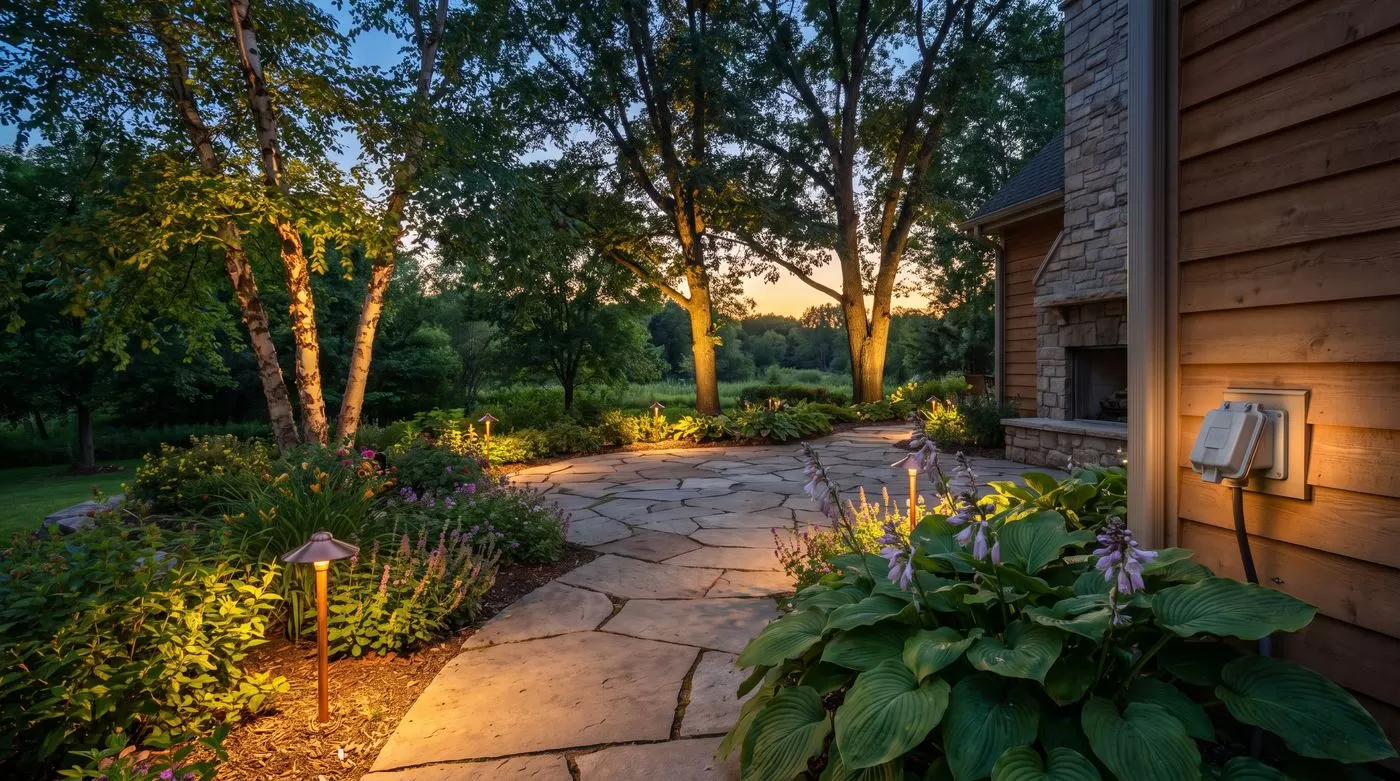
Every outdoor outlet in Minnesota must be GFCI-protected (National Electrical Code 210.8). That can mean a GFCI outlet itself, or a GFCI breaker upstream protecting the circuit. The outlet must have a weatherproof box and a weather-resistant, tamper-resistant receptacle (TR/WR-rated). And — this is the one homeowners miss — it needs a “weatherproof while in use” cover (also called an in-use cover or bubble cover) that closes even when a cord is plugged in.
Standard “weatherproof” covers that flip up to expose the outlet and snap shut over an empty outlet are not code-compliant for new outdoor outlets. The 2014 NEC tightened this — covers must protect against water while a cord is plugged in, which means a deeper bubble cover. We see hundreds of older homes with the old style; they’re grandfathered in, but any new outlet has to use the in-use type.
Landscape Lighting: Line Voltage vs. Low Voltage
Most residential landscape lighting is low-voltage (12V) and runs off a transformer that plugs into a standard outdoor GFCI outlet. The 12V side has very little code regulation — you can run the wires above-ground if you want, splice them with waterproof connectors, and place fixtures wherever you like. Pre-made kits from any big-box store are typically low-voltage. This is the path 90% of homeowners take, and it’s fine.
Line-voltage (120V) landscape lighting requires direct-burial cable in conduit, a permit, and a licensed electrician. It’s more expensive but used when you want brighter output, longer runs, or path lighting that doesn’t depend on a transformer that can fail. Line-voltage also has to follow code burial depths (usually 12-18″ depending on the cable type) and protection at any rises out of the ground.
Common Outdoor Mistakes We Fix
(1) GFCI outlets that aren’t actually GFCI — homeowner replaced a worn outlet with a standard one and the breaker upstream isn’t GFCI either. (2) In-use covers facing the wrong way so water collects in the back. (3) Landscape transformers buried in mulch with no GFCI feed. (4) Hot tub disconnect installed too close to the tub (code requires 5-10ft of separation). (5) Direct-burial cable just laying on the ground because the homeowner ran out of patience for trenching.
All of these can be fixed without a major rewire. The most common job we do in this category is converting a non-GFCI outdoor outlet to a proper GFCI with an in-use cover — ~30 minutes per outlet, $75-125 per outlet installed (less for multiple in one visit). For property managers with portfolios of older buildings, we do whole-portfolio outdoor outlet audits at $50 per unit.
Frequently Asked Questions
Do I need a permit for an outdoor outlet?
Yes — Minnesota code requires a permit for any new electrical work, including outdoor outlets. Replacing an existing outlet at the same location is a gray area but most cities still want a permit pulled. Permit fees range $50-100 depending on the city.
Can I run an extension cord permanently to an outdoor light or feature?
No — code prohibits permanent extension-cord use. If you need power 20 feet from the house, the right answer is a properly installed outlet, not a permanent extension cord. Extension cords are a fire hazard outdoors and a tripping hazard.
What about outlets for holiday lights in the eaves?
Eave outlets are great — they keep extension cords off the ground and the wiring inside the soffit. We install dedicated soffit outlets controlled by an indoor switch (or a smart switch) so you can turn the lights on from inside. Typically $300-500 per outlet depending on how easy it is to fish wire.
Do GFCI outlets work in cold Minnesota winters?
Yes — modern GFCIs are temperature-rated for full Minnesota winters. Older GFCIs (pre-2010) sometimes nuisance-trip in extreme cold. If yours trips when temperatures drop, replace it with a current-generation GFCI rated for -35°F.
Can you install an outlet on a deck or fence?
Yes — deck outlets are common. They must be mounted in a weather-resistant box, GFCI-protected, with an in-use cover. Fence outlets are similar but require we drop a conduit run from the house through proper trenching and burial. Both are typical 1-day jobs.
Get Outdoor Electrical Done Right
Adding outlets, landscape lighting, or a patio circuit? We do outdoor electrical across the south Twin Cities, fully permitted with in-use covers, GFCI protection, and proper burial. Call 651-418-1476 or book online.