
Knob and Tube Wiring: What to Do If You Find It in a Twin Cities Home

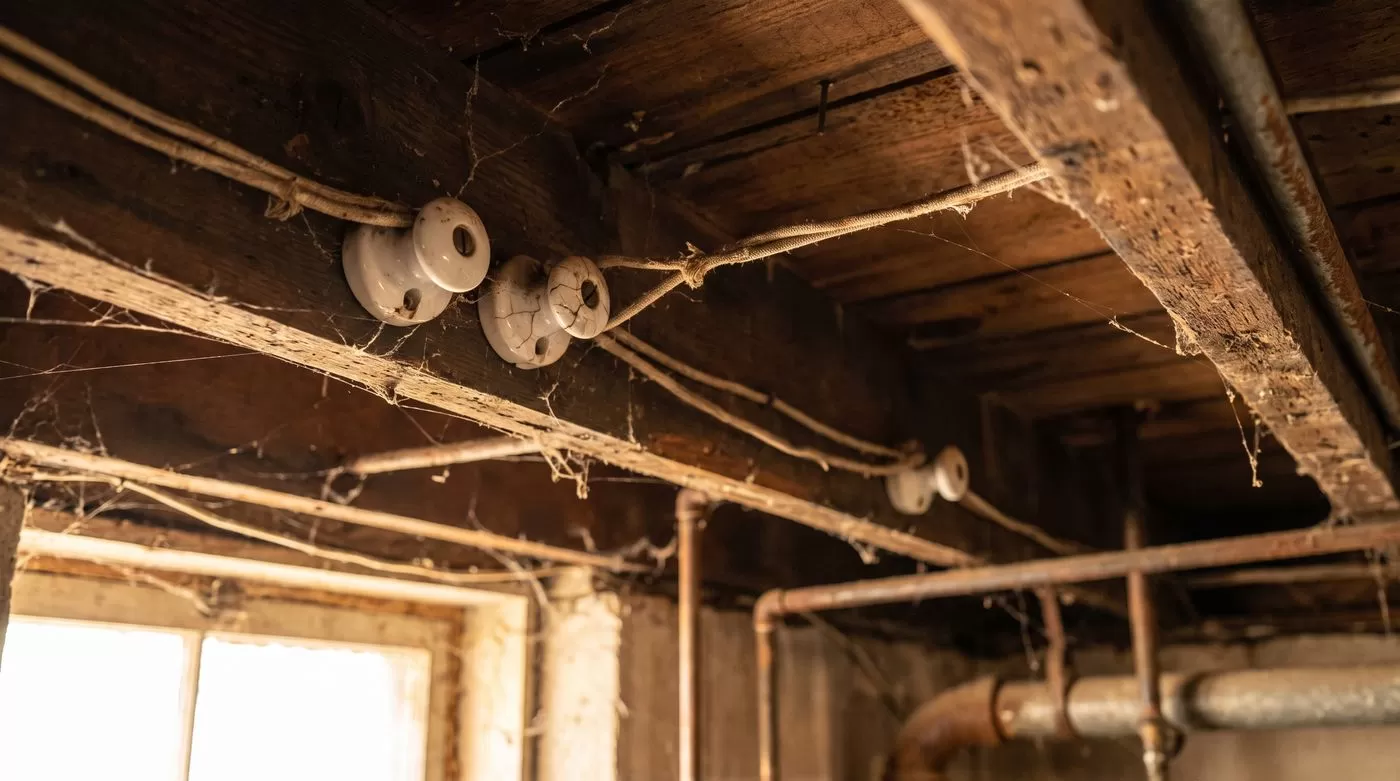
Knob-and-tube (K&T) wiring was the residential standard from roughly 1880 to 1940. You’ll still find it in some south Twin Cities homes, particularly in attics and crawlspaces of pre-1950 builds in older West Saint Paul, Newport, Hastings, and downtown areas. K&T is two single conductors run separately through ceramic knobs and ceramic tubes — no insulation, no ground, no junction boxes in many cases. It’s not inherently “dangerous” if untouched but it doesn’t tolerate modern loads, building insulation, or modern repair work. Most insurance companies now want it removed.
How to Identify Knob and Tube
K&T is unmistakable when you see it. Two separate single conductors (one hot, one neutral) running through white porcelain insulator knobs on joists and rafters, and through ceramic protective tubes when they pass through wood. Connections are soldered and wrapped in cloth tape. There are no junction boxes — splices happen in midair, supported by the knobs. The cloth insulation is brittle and crumbles when handled.
Where to look: unfinished attic spaces, basement ceilings where joists are exposed, crawlspaces. If you have an early 1900s home and it has not been completely rewired, you almost certainly have K&T somewhere in the structure. Some homes are partially rewired (modern wiring on lower floors, K&T still in the attic).
Why It Has to Go
Three main reasons. (1) Modern building insulation surrounds and traps heat on K&T conductors, which were designed to dissipate heat through open air. Adding attic insulation over K&T is a serious fire risk and most cities now prohibit it. (2) K&T has no ground wire, so modern three-prong appliances can’t be properly grounded — GFCI retrofits help but don’t restore equipment safety. (3) The cloth insulation is 80-100 years old and crumbles when disturbed, exposing bare conductors.
Insurance companies have been pulling back on K&T policies for the last 10 years. Many major insurers now refuse to write new policies on homes with active K&T, and some will not renew existing policies. The remediation they want is complete removal and replacement with modern Romex (NM-B) cable. Some insurers accept K&T in conduit (functionally a rewire anyway) or accept inactive/abandoned K&T if all branch circuits have been replaced.
What Replacement Costs and Looks Like
Whole-home K&T replacement in a typical south-metro 2-story home: $12,000-22,000 depending on size, wall finish, and access. The work is largely about access — fishing new wires through walls without tearing up plaster, fishing through floor joists, replacing every outlet, switch, and fixture box. We use a combination of attic-down and basement-up fishing for most rooms; some walls require small access cuts that the GC patches afterward.
Partial replacement (just the circuits in active use, leaving abandoned K&T in walls): $6,000-12,000. This is the approach we recommend when budget is the constraint. Truly abandoned K&T (disconnected at both ends, no live current) is not a fire hazard, but insurers still sometimes flag it on inspection. Disclosure becomes important at sale.
Frequently Asked Questions
Is knob and tube wiring illegal?
It’s not illegal to have it, but it’s not allowed in new installations and most cities prohibit adding to it. Code-compliant K&T installations from 1900-1940 are grandfathered, but any modification, extension, or new circuit must be modern wiring.
Can I get homeowner’s insurance with K&T wiring?
Increasingly difficult. State Farm, Allstate, Farmers, and most major insurers refuse new policies. Some specialty insurers (with higher premiums) will write coverage. If you have existing coverage on a K&T home, sale to a new buyer may trigger the insurance question.
Can I add modern outlets to existing K&T circuits?
Code doesn’t allow it. Any new outlet must be on modern Romex with a ground conductor. We can sometimes route a new circuit from the panel to a single room while leaving K&T in other parts of the house, which is partial-rewire territory.
How disruptive is whole-home K&T replacement?
Moderately disruptive. Most of the work is in the attic, basement, and at outlet/switch locations. We typically take 5-10 days for a 2-story home. Wall patching is usually done by the GC or homeowner afterward, since it requires plaster/drywall finishing work.
Do you do K&T replacement in occupied homes?
Yes — most of our K&T jobs are in occupied homes. We work room by room, restore power to each room at the end of each day, and keep at least one functional circuit available at all times. Total power-off time for the whole house is usually <4 hours over the duration of the project.
Get a Knob & Tube Replacement Quote
Whole-home K&T replacement is one of our specialties. In-home assessment, written quote with phasing options, fully permitted. Call 651-418-1476 or book online. Insurance documentation included.