
Federal Pacific Stab-Lok Panel Replacement: Why and How

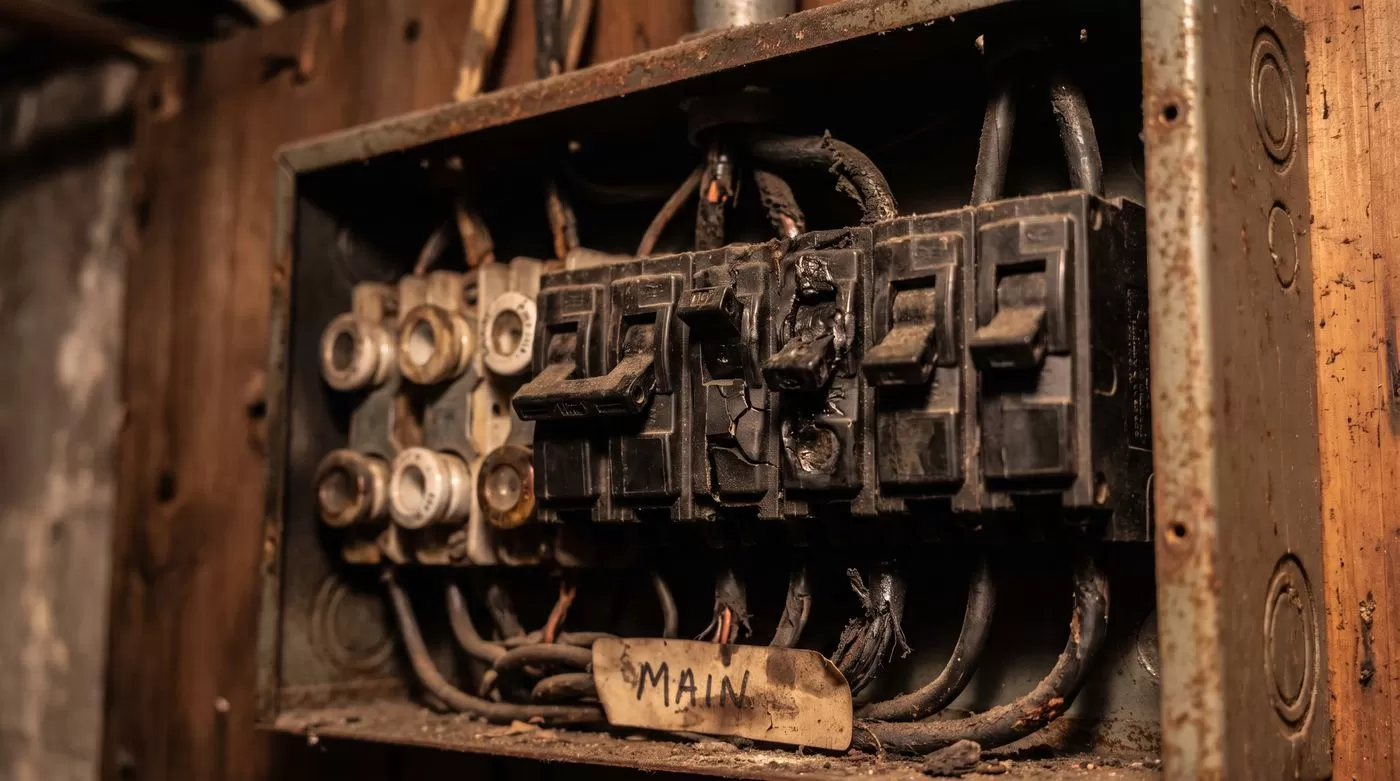
Federal Pacific Electric (FPE) Stab-Lok panels were installed in millions of American homes between the 1950s and 1980s. They look unremarkable from the outside — a beige or grey metal panel with breakers stacked in two columns. Inside, they have a documented history of failing to trip during electrical faults, which means an overloaded or short-circuited wire can keep feeding current that should have been cut off. That’s how electrical fires start. If you have one of these panels and you didn’t know — you’re not alone. Most homeowners never get told. Here’s how to identify one, why it matters, and what to do.
How to Identify a Federal Pacific Stab-Lok Panel
Open your panel door (just the door, not the cover). Look for the Federal Pacific name or logo on the inside of the door, the front of the breakers, or the panel label. The breakers themselves have a distinctive look — single-color (red or black) plastic with a thin rectangular profile. If you see Stab-Lok anywhere or Federal Pacific Electric, that’s your panel.
FPE panels were most commonly installed in homes built 1955-1985. If your house is in that era and you’ve never updated the panel, there’s a non-trivial chance you have one. We’ve found them in West Saint Paul, South Saint Paul, Cottage Grove, Inver Grove Heights, and across the older south metro housing stock. Send us a photo of your panel label and we’ll tell you definitively.
Why FPE Panels Are a Documented Risk
Independent testing in the 1980s and 90s found that FPE Stab-Lok breakers had failure rates much higher than industry standards. The breakers can fail in two ways: failing to trip when they should (the worst case — current keeps flowing through an overloaded circuit, heating wires until something ignites), or appearing to trip but not actually disconnecting the internal contacts. CPSC investigations in the 1980s flagged the issue. UL revoked the FPE Stab-Lok listing. The company eventually went out of business.
What does that mean practically? It doesn’t mean every FPE panel will catch fire. Many have operated for decades without incident. But the failure rate is high enough that home insurance companies increasingly flag FPE panels during underwriting — some won’t insure homes that still have them. Several Twin Cities home buyers in the last few years have made FPE panel replacement a condition of closing.
Replacement: One-Day Job, Clean Process
Replacing a Federal Pacific panel is the same labor as any other panel swap — pull the meter with Xcel briefly, remove the old panel, install the new one (typically a Square D, Eaton/Cutler-Hammer, or Siemens depending on availability and your preference), re-terminate all the branch circuits, ground/bond per current code, and have the inspector sign off the same afternoon. One day on site, no drywall damage, power back on by mid-afternoon.
Most FPE replacements run $2,200-$3,800 depending on whether the meter base needs replacement and whether the existing circuits need any code-related updates during the swap. We include the permit, the inspection, the meter coordination with Xcel, and the cleanup in the written quote. Wisetack financing available on projects over $500. The vast majority of homeowners tell us replacement felt overdue once it was done — the new panel labels were correct, the panel cover came off cleanly for the first time in 40 years, and they sleep better.
Frequently Asked Questions
How common are Federal Pacific panels in the Twin Cities?
Common enough that we find one on most safety walkthroughs of homes built 1960-1985. The south metro housing stock — South Saint Paul, West Saint Paul, Inver Grove Heights, parts of Cottage Grove and Woodbury — has them at higher rates than newer suburbs.
What is the insurance angle on FPE panels?
Several major insurance carriers now flag FPE panels during underwriting and may charge higher premiums, require replacement before issuing a policy, or refuse coverage altogether. Check with your carrier before assuming yours is fine.
Are Zinsco or Pushmatic panels also a concern?
Zinsco panels have similar documented issues — failure to trip, melted bus bars. We treat Zinsco replacement with the same urgency as FPE. Pushmatic is less of a known safety issue but parts availability is poor, so replacement is recommended when major work is needed anyway.
Can I keep the old breakers and just swap the panel?
No — breakers are panel-specific and the whole purpose of replacement is removing the failure-prone components. New panel, new breakers throughout.
How long does the replacement take?
One day on site for a typical residential FPE replacement. Power off mid-morning, back on mid-afternoon. Inspector usually same-day or next morning.
Will the inspector tell me I have an FPE panel?
Sometimes during a real-estate inspection, but home inspectors aren’t required to flag it. Some do, some don’t. The safest path is to check yourself by looking at the panel label.
Get an FPE Panel Assessment
Open the panel door and take a photo of the label and the inside-door logo. DM it to us or send it in via the contact form. We’ll tell you straight if it’s something to worry about.
Call 651-418-1476 or send us a photo. Replacement quoted in writing, permit + inspection included, Wisetack financing available.