Electrical work comes with a lot of jargon. This plain-English glossary explains the terms Twin Cities homeowners run into most — on inspection reports, quotes, and permit paperwork — so you can make confident decisions about your home. Questions about any of these? The licensed team at Three Rivers Electric is happy to explain.
- Your Electrical System
- Safety Devices
- Wiring & Materials
- Power & Measurement
- Upgrades & Add-Ons
- Permits & Code
Your Electrical System
- Amperage (Service Size)
- The total electrical capacity of your home, measured in amps. Older homes often have 100-amp service; most modern homes need 200-amp service to handle EV chargers, hot tubs, and heat pumps.
- Circuit Breaker
- A switch that automatically shuts off a circuit when it draws too much current, preventing overheating. A breaker that trips repeatedly is a sign something needs attention.
- Dedicated Circuit
- A circuit that serves a single appliance (like a microwave, EV charger, or furnace) so it isn’t overloaded by sharing power with other devices.
- Disconnect
- A switch that completely cuts power to a piece of equipment (such as an AC unit or generator) for safe service.
- Federal Pacific & Zinsco Panels
- Two obsolete panel brands, common in homes built from the 1950s through the 1980s, whose breakers have a documented history of failing to trip during a fault. Both are widely treated as a fire hazard and often get flagged by home inspectors and insurers. We replace them on sight rather than trust them.
- Meter / Meter Socket
- The utility’s device that measures how much electricity you use, and the enclosure it plugs into where utility power enters your home.
- Service Mast / Weatherhead
- The metal pipe and weatherproof cap (the weatherhead) that carries an overhead power line down to your meter. On a service upgrade, an old or undersized mast usually gets replaced along with the panel.
- Service Panel (Breaker Panel / Load Center)
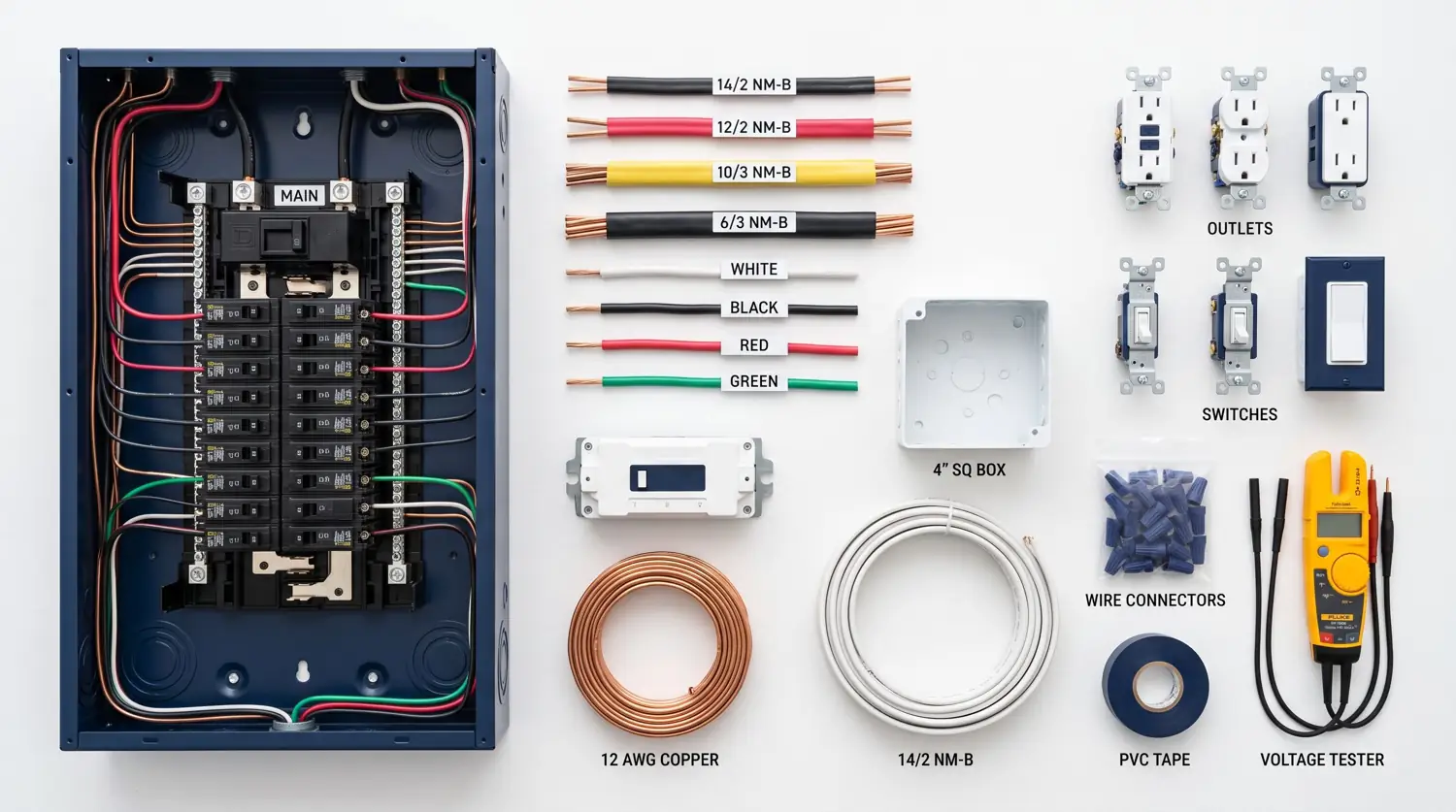
- The metal box where power from the utility is split into the circuits that feed your home. Each circuit gets its own breaker. Check whether your panel has room for new loads.
- Subpanel
- A smaller secondary panel fed from the main panel, used to add circuits for a garage, addition, or workshop without running everything back to the main box.
Safety Devices
- AFCI (Arc-Fault Circuit Interrupter)
- A breaker that detects dangerous electrical arcing (a common cause of house fires) and cuts power before it ignites. Now required for most living-area circuits.
- Bonding
- Connecting metal parts (pipes, panels, equipment) together so they stay at the same electrical potential, preventing dangerous voltage differences.
- GFCI (Ground-Fault Circuit Interrupter)
- An outlet or breaker that shuts off power in a fraction of a second if it detects current leaking to ground — required near water (kitchens, baths, outdoors) to prevent shock.
- Grounding
- A safety path that directs stray electricity harmlessly into the earth, reducing shock and fire risk. Older homes sometimes lack proper grounding.
- Hardwired Smoke & CO Detectors
- Detectors wired into your home’s power (with battery backup) and interconnected, so when one alarms they all do.
- Whole-Home Surge Protector
- A device installed at the panel that absorbs voltage spikes from storms or the grid, protecting everything plugged into your home at once.
Wiring & Materials
- Aluminum Wiring
- Common in homes built in the 1960s–70s. Aluminum expands and loosens at connections over time, creating fire risk unless properly remediated.
- Conduit
- Rigid or flexible tubing that protects wiring, typically required in garages, basements, and outdoor or exposed runs.
- Hot, Neutral & Ground
- The three conductors in a standard circuit: the hot carries current to the device, the neutral returns it, and the ground is a safety path.
- Junction Box
- An enclosed box where wires connect or branch. Code requires connections to be inside an accessible box — never hidden in a wall.
- Knob-and-Tube Wiring
- An early-1900s wiring method using ceramic knobs and tubes. It lacks a ground, degrades over time, and is often a safety and insurance concern — many older Twin Cities homes still have some. Learn about rewiring.
- Receptacle (Outlet)
- The point where you plug in devices. 15-amp and 20-amp versions exist; some appliances require the higher-capacity 20-amp type.
- Romex (NM Cable)
- The flat plastic-sheathed cable used for most modern residential wiring, containing hot, neutral, and ground conductors.
Power & Measurement
- Backfeed
- Electricity flowing the wrong direction into the grid — a serious hazard with improperly connected generators, which is why a transfer switch is essential.
- Brownout (Voltage Sag)
- A temporary drop in voltage that can cause lights to dim and strain motors and electronics.
- Kilowatt-Hour (kWh)
- The unit your utility bills you by — one kilowatt of power used for one hour.
- Power Surge
- A brief spike in voltage — from lightning, grid switching, or large appliances — that can damage electronics over time.
- Single-Phase vs. Three-Phase
- Homes use single-phase power; larger commercial buildings often use three-phase, which delivers more power more efficiently for heavy equipment.
- Volt, Amp & Watt
- Volts measure electrical “pressure,” amps measure the flow of current, and watts measure power used (volts × amps). Standard U.S. outlets are 120 volts; large appliances use 240 volts.
Upgrades & Add-Ons
- EV Charger (Level 1 vs. Level 2)
- Level 1 charges from a standard 120V outlet (slow); Level 2 uses a 240V circuit for much faster charging and usually needs a dedicated circuit. EV charger installation.
- Load Calculation
- A code-based calculation of your home’s total electrical demand, used to confirm your panel and service can handle new equipment.
- Load Management
- A device or smart panel that lets a big new load, like an EV charger or heat pump, share capacity with your existing circuits instead of forcing a full service upgrade. It watches total draw and throttles or sheds lower-priority loads when demand spikes.
- Recessed Lighting (Can Lights)
- Light fixtures installed flush into the ceiling for a clean, modern look.
- Service Upgrade (“Heavy-Up”)
- Increasing your home’s electrical capacity — usually from 100 to 200 amps — to safely support modern demand. See panel upgrades.
- Smart Panel
- A modern panel that lets you monitor and control circuits from your phone and manage backup power and solar.
- Standby Generator
- A permanently installed generator that powers your home automatically during an outage. Size your generator.
- Transfer Switch
- The device that safely switches your home between utility power and generator power, preventing dangerous backfeed.
Permits & Code
- Code Compliance
- Meeting all applicable safety rules. Non-compliant work can fail inspection, void insurance, and create hazards — a key reason to hire a licensed pro.
- Inspection
- A review by a local inspector confirming the work meets code before it’s energized or closed up.
- NEC (National Electrical Code)
- The national safety standard for electrical installations, updated every few years and adopted (with local amendments) across Minnesota.
- Permit
- Authorization from your city or county to perform electrical work, ensuring it’s done to code and inspected. Licensed electricians pull permits as part of the job.
Still have an electrical question?
Licensed · Family-owned · Serving the Twin Cities Metro and surrounding areas